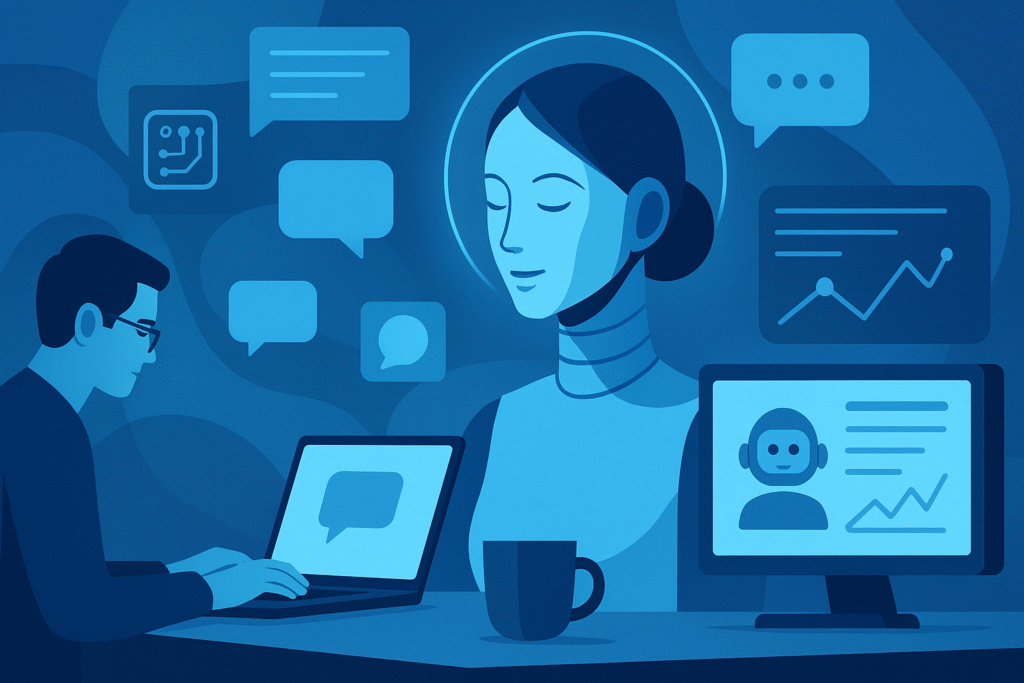
Artificial Intelligence has moved from sci-fi speculation to everyday reality. What began with simple chatbots responding to pre-set commands has now evolved into intelligent assistants that can code, design, write, analyse, and even make creative decisions. These AI companions are no longer tools; they are collaborators — reshaping the way people think, work, and create.
The Shift from Automation to Collaboration
AI’s first phase was about automation — replacing repetitive, low-value tasks with software. From customer service bots to data entry automation, AI freed humans from the mundane. But today’s revolution is different. It’s about collaboration.
Modern AI assistants don’t just execute instructions — they participate. They understand tone, context, and even emotion. They can write an article, generate design concepts, create a business pitch deck, or debug code within seconds. This shift from “task-doer” to “co-creator” marks the biggest transformation since the internet.
Why Businesses Are Adopting AI Assistants
Businesses are under constant pressure to increase productivity while reducing cost. AI assistants deliver both.
In marketing, they write content, analyse engagement, and optimise SEO strategies in real time.
In development, they review code, generate snippets, and suggest fixes.
and design, they create variations of logos or banners with creative balance that rivals professionals.
The key value isn’t replacement — it’s amplification. An employee empowered with an AI assistant performs like a team of three.
AI’s Role in Personal Productivity
AI assistants aren’t just for businesses. On the personal front, they’re transforming how people manage time and decisions. Imagine a daily AI scheduler that studies your behaviour and arranges meetings during peak focus hours, or a personal learning assistant that curates lessons based on your career goals.
We’re entering an era of “augmented living,” where AI quietly handles the background noise — freeing human minds for deeper, creative work.
Challenges: Ethics, Privacy, and Dependency
But not all progress is perfect. The rise of AI assistants introduces a new dilemma — trust. When a system can write like you, think like you, or make decisions for you, where does control end and convenience begin?
Privacy remains a critical concern. AI models learn from user interactions, which can expose sensitive data. Responsible AI development must focus on transparency, consent, and secure data practices.
Another risk is dependency. Overreliance on AI can reduce human problem-solving ability. The solution lies in balance — using AI as a partner, not a crutch.
The Future: Emotional and Contextual Intelligence
The next evolution of AI assistants won’t just understand commands — they’ll understand intent. Imagine an AI that recognises frustration in your tone and adjusts its approach, or one that senses urgency and prioritises accordingly. Emotional intelligence will redefine user experience.
We’re approaching a future where AI won’t just respond; it will anticipate. And that’s both exciting and unsettling.
Final Thoughts
AI assistants are not replacing humans — they’re rewriting what it means to be productive. The future of work isn’t man vs machine; it’s man with machine. The smartest workers of tomorrow won’t fear AI — they’ll master it.