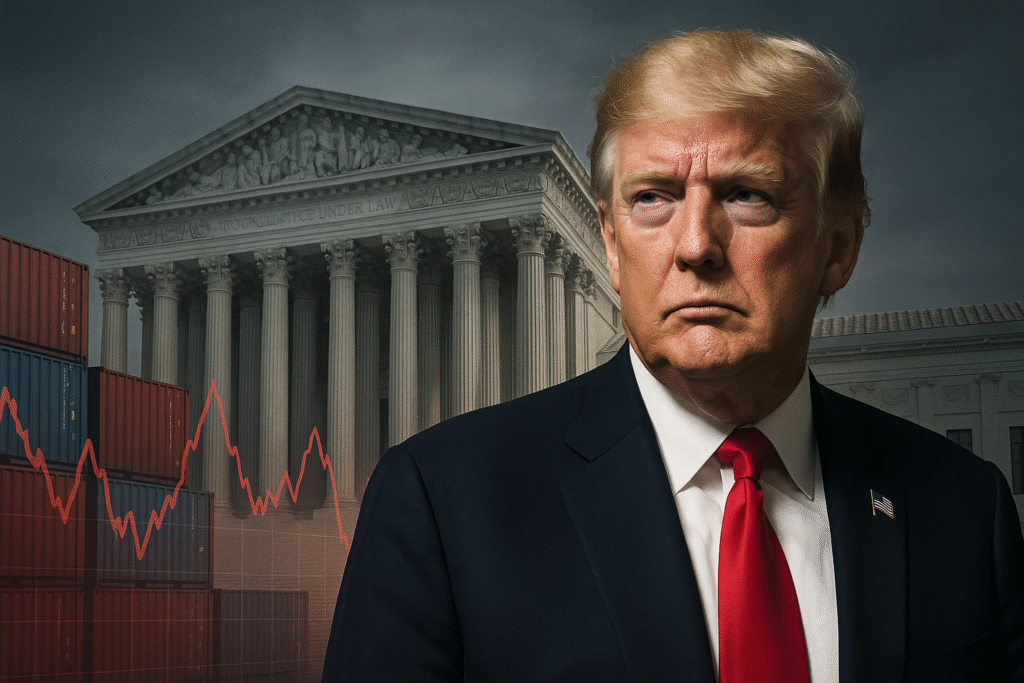
The upcoming US Supreme Court hearing on Donald Trump’s tariff powers may feel like a purely American legal debate — but make no mistake, the consequences reach far beyond Washington. The United Kingdom, already navigating post-Brexit trade uncertainty, stands directly in the line of fire.
If the Court upholds Trump’s broad authority to impose tariffs without Congressional approval, global trade becomes less predictable. And in trade, unpredictability is expensive.
Why the UK Should Be Paying Attention
The UK is not just a neutral spectator here. The UK exports billions in goods to the United States — from cars and aerospace components to pharmaceuticals and whisky.
If Trump’s approach to trade is legally reinforced, it signals one thing:
The US can change trade conditions overnight, without negotiation.
That makes planning sales, investment, and supply chains significantly harder for British manufacturers.
The Bigger Problem: The UK Has Less Leverage Now
Before Brexit, the UK had the EU’s negotiating weight behind it.
Post-Brexit, the UK stands alone at the trade table.
If Washington decides to pressure trade partners, the UK is simply easier to squeeze than the EU, China, or Canada.
This means:
- Higher tariffs could be placed on UK goods more easily
- UK firms may face cost disadvantages in the US market
- Any trade concessions could come with political strings attached
This is the reality of “Global Britain”: more autonomy, less leverage.
What Sectors in the UK Are Most at Risk
| Sector | Why It’s Vulnerable | Potential Impact |
|---|---|---|
| Automotive (Midlands & North) | Relies on cross-border parts and export margins | Job pressure, production slowdowns |
| Whisky & Food Producers (Scotland) | Luxury/heritage goods are easy targets for tariffs | Reduced US shelf presence |
| Pharma & Biotech (Cambridge, London hubs) | Regulatory cooperation is critical | Slower approvals and export delays |
| Aerospace (Bristol, Wales) | Deep US supply chain linkage | Contract renegotiations and margin shrink |
This isn’t theoretical — we’ve already seen how fragile sector confidence is since Brexit.
If the Court Rules Against Trump — Don’t Assume Relief
Even a ruling limiting tariff powers changes little for the UK:
- Trump’s trade strategy is now politically mainstream in the US.
- Protectionism is not “Trump policy” anymore — it’s American policy trend.
- The next administration, regardless of party, is unlikely to return to full free-trade openness.
So whether the Court says “yes” or “no”, the UK is still exposed.
What the UK Should Be Doing Now (But Probably Won’t)
1. Build Supply Chains Closer to Home
Continue shifting production from Asia to Europe and domestic facilities.
2. Strengthen Strategic Trade with India and Japan
These two markets offer leverage the US respects.
3. Stop Waiting for a US-UK Trade Deal
It’s not coming any time soon. Accept it and plan accordingly.
4. Support British Manufacturers With Real Incentives
Not slogans. Not campaigns. Actual manufacturing subsidies and research credits.
The government loves talking about “growth industries”. It’s time to fund them.
Conclusion
The Supreme Court hearing on Trump’s tariffs is not just a legal event. It’s a warning shot for countries who depend on stable access to the US market — and the UK is high on that list.
The UK cannot afford to treat this as distant news. It affects jobs, exports, investment strategies, and the future shape of British manufacturing.
The world is entering an era where trade is strategic, not cooperative.
The UK needs to stop reacting after the shock, and start positioning before the impact.