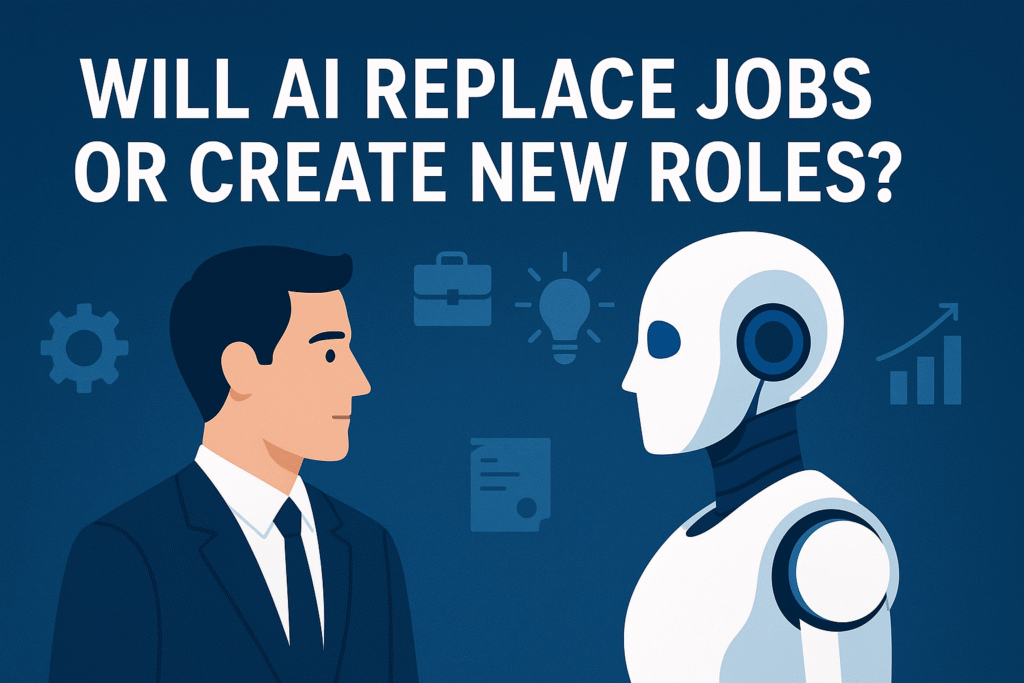
Artificial Intelligence (AI) is no longer a futuristic concept — it’s the driving force transforming industries, redefining skills, and reshaping how we work. From automation in factories to smart assistants in offices, AI has rapidly evolved from being a helpful tool to an essential business ally. But the question remains — will AI replace jobs, or will it create new ones?
The Fear of Replacement
One of the biggest concerns surrounding AI is job displacement. As machines and algorithms become capable of performing complex tasks, many fear that human workers will become redundant. Roles that involve repetitive, rule-based, or data-heavy tasks are at the highest risk.
For instance, manufacturing, data entry, and even customer support are increasingly automated. Chatbots now handle thousands of customer queries daily, and self-driving technology threatens the future of driving-based professions.
However, this is only one side of the story.
The Rise of New Opportunities
History shows that every major technological revolution — from the industrial era to the digital age — has replaced certain jobs but created entirely new industries and roles. AI is no different.
As automation takes over routine tasks, it opens up space for new kinds of work — jobs that focus on creativity, innovation, emotional intelligence, and complex problem-solving.
AI itself has given birth to entirely new career paths such as:
- AI Ethics Officers who ensure technology is developed and used responsibly.
- Prompt Engineers who design and refine AI interactions.
- Data Scientists and AI Trainers who feed and optimise algorithms.
- Automation Consultants who help businesses integrate AI strategically.
- AI Product Managers who lead innovation across industries.
The future workforce will be defined not by who can compete with machines, but by who can work with them.
Reskilling: The Key to Adaptation
As AI evolves, so must the workforce. Continuous learning and reskilling are now essential. Educational systems and organisations are shifting towards hybrid skillsets — blending technical literacy with human-centric abilities like critical thinking, communication, and leadership.
AI may automate tasks, but it cannot replace human creativity, empathy, or intuition. The people who adapt, learn, and evolve will find themselves not out of work — but at the forefront of the next wave of opportunity.
Industries Leading the AI Transformation
Certain sectors are already showcasing how AI can enhance rather than erase jobs:
- Healthcare: AI supports diagnosis and patient care, while doctors focus on empathy and treatment.
- Finance: Automation handles data analysis, freeing experts to focus on strategy and advisory roles.
- Marketing: AI tools analyse audience behaviour, but creativity and storytelling still depend on humans.
- Education: Smart tutoring systems personalise learning, while teachers take on more mentorship-oriented roles.
These examples prove that AI is not the end of employment — it’s the evolution of it.
A Balanced Future
AI is not a job killer; it’s a job transformer. It will eliminate outdated roles but simultaneously generate opportunities that demand new skills and perspectives. The key lies in embracing change rather than fearing it.
Governments, businesses, and individuals must collaborate to build a balanced future — one where AI amplifies human potential rather than replaces it.
The question is not “Will AI take our jobs?” but “How can we use AI to make our jobs better?”
Conclusion
AI is undeniably changing the employment landscape, but its true impact depends on how society adapts. Those who learn to work with AI, rather than against it, will thrive in this new era. The future of work isn’t about humans versus machines — it’s about humans empowered by machines.